Objectives
In CLOSER, our work is driven by the following objectives:
Co-create solutions with people on the ground
We don't build tools in an ivory tower. We aim to design practical frameworks that solve real-world problems—from immediate disaster response to long-term climate planning.
Advance integrated data on climate-related disasters
We are creating a single, open-access database that connects past extreme weather events to their actual human, social, and economic impacts.
Model the real impacts of climate disasters
Extreme weather rarely hits in isolation. We capture the complexity of hazards, vulnerabilities, policies and other adaptations.
Uncover disaster drivers
We expand climate attribution science beyond just the weather. Our goal is to allow decision-makers to see how much a disaster was driven by rising temperatures versus bad planning decisions.
Learn from past policy mistakes to protect vulnerable communities
We analyze past and present policies to see mistakes and successes, and how they impacted different social groups. We want to help leaders design better, justice-focused policies for future disasters.
How We Do It: Our Methods (On the ground)
We bring together expertise across climate, AI, social science, and risk to solve a single challenge: understanding complex disasters in their full human and environmental context.
We achieve our objectives through two interlinked levels of action:
The Global Disaster Database
We draw from satellite imagery, deep learning, AI text-mining, and historical news records to create a coherent, open database mapping climate hazards and human exposure.
Our Attribution and Forecasting tool
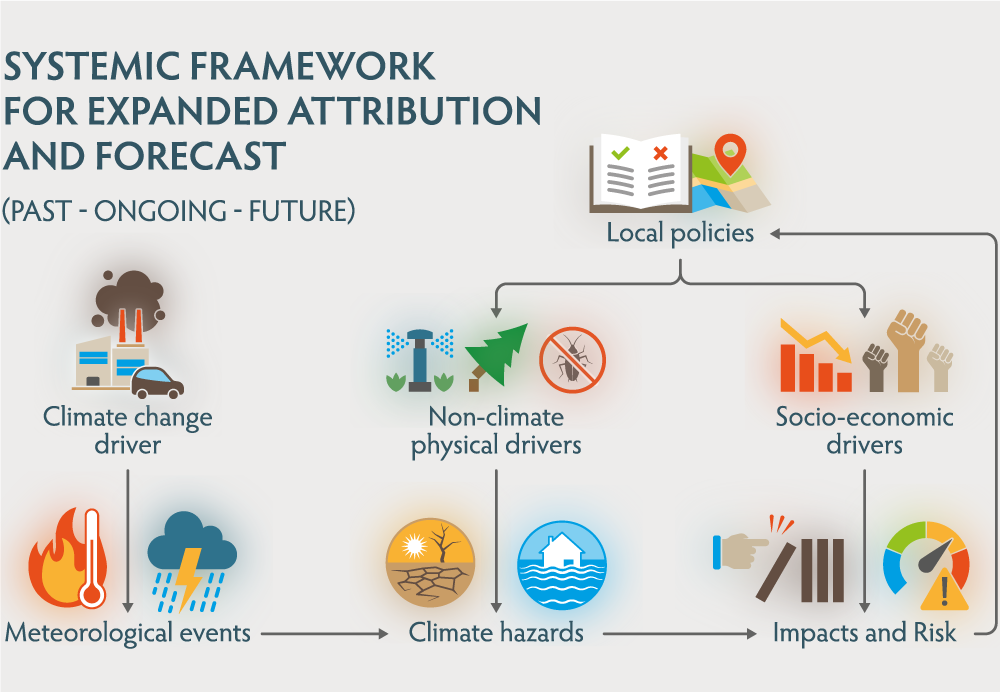
A step-by-step method that untangles the causes of disasters. It attributes past, current, and future impacts not just to global warming, but to local human choices—like land misuse, groundwater depletion, and urban planning.
Implementable Decision-Making Frameworks
We translate complex data and policy research into practical guides, interactive web simulations, and educational tools that help decision-makers evaluate policy options and protect vulnerable populations.
Our Methods (Globally)
On the ground:
We test and refine our science across six Case Applications facing complex, recurring climate disasters.
Co-Creation
Instead of working in isolation, we set up collaborative workshops directly with local emergency responders, weather services, and planning agencies in places like the Caribbean, Senegal, and Punjab.
Testing Real Needs
Together we co-design event definitions, run disaster simulations, and ensure every tool we build directly serves local decision lead times and community needs.
Across the Globe:
What we learn on the ground is scaled up to benefit communities worldwide through:
Advisory Board
We invite established professionals to help us reach our objectives
Advisory person 1
Advisory person 2
Advisory person 3
Advisory person 4
Advisory person 5